SHRM CP Situational Questions
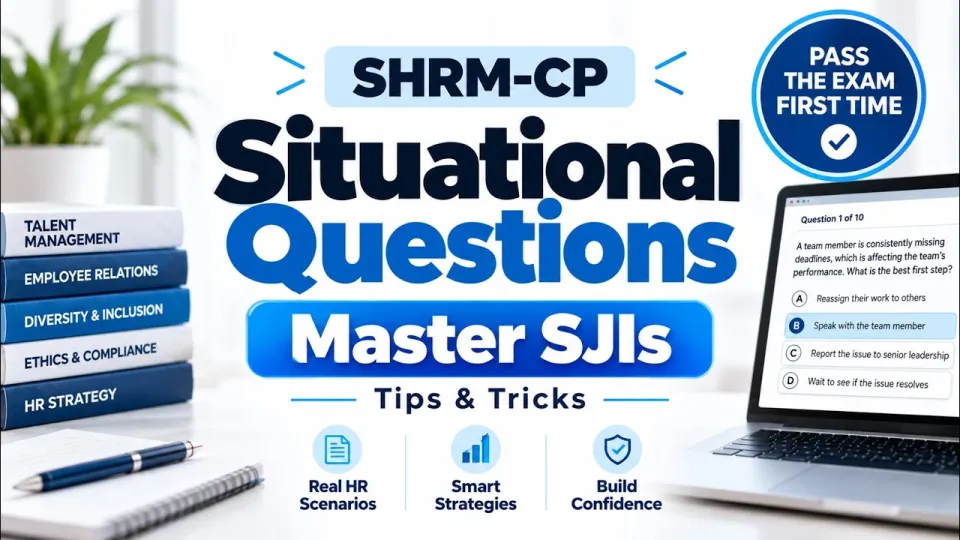
Video: SHRM CP Situational Questions (SJIs) | TIPS TO PICK THE RIGHT ANSWER
SHRM CP Situational Questions are designed to evaluate your ability to apply HR knowledge to complex workplace scenarios. To pick the right answer, it's critical to understand whether the question asks for the immediate next step or the overall most effective solution. Applying a structured approach involving five decision checks will help you make informed choices. For practice questions and registration, visit PrepSolution's free SHRM-CP practice questions.
Understanding SHRM CP Situational Questions
Situational Judgment Items (SJIs) on the SHRM CP exam present HR-related dilemmas where multiple answers seem reasonable. The challenge lies in selecting the best response that aligns with SHRM competency model, ethical standards, and organizational policy. Unlike knowledge-based questions, situational questions test your judgment, prioritization, and adherence to legal and ethical HR practices.
The Key: First Step vs Most Effective Action
One of the most common traps in SHRM CP situational questions is confusing the first appropriate action with the most effective or final resolution. Some questions specifically ask for the "next step," which implies a sequence of actions, while others want the "best" or most comprehensive action to resolve the issue.
To distinguish these:
- Carefully read the question prompt and note keywords like "next," "immediate," or "best."
- Identify if the scenario requires escalation, investigation, or direct intervention.
- Align your choice with the logical sequence of HR processes.
Five Decision Checks to Evaluate Answers
When analyzing each answer option, apply these five decision checks to judge appropriateness:
- Facts: Are you considering all scenario details without assumptions?
- Policy and Law: Does the action comply with organizational policies and employment laws?
- Appropriate Escalation: Is the response escalating the issue correctly or unnecessarily?
- HR’s Role: Does the choice fit HR's responsibilities without overstepping?
- Involved People: Are all relevant stakeholders considered and properly engaged?
These checks help avoid common pitfalls like legally defective options or ignoring key facts.
Common Answer Traps and How to Avoid Them
Five major traps often mislead test-takers:
- Premature Action: Jumping to disciplinary measures without gathering facts.
- Passive Responses: Ignoring or delaying action when intervention is needed.
- Taking Over Manager’s Role: HR should support, not substitute, managerial responsibilities.
- Unnecessary Escalation: Escalating to senior management when the issue can be resolved at a lower level.
- Legally Defective Options: Choosing actions that violate employment laws or company policy.
Spotting these traps requires careful reading and cross-checking each option against the scenario and SHRM standards.
Practical Elimination Tips
To narrow down answer choices:
- Test each option against scenario facts and question wording rather than relying solely on personal workplace experience.
- Eliminate answers that conflict with policy or legal requirements.
- Discard options that shift responsibility improperly or create unnecessary conflicts.
- Prioritize options that promote fair, ethical, and effective HR practices.
Applying the Method: A Workplace Scenario Example
Consider a scenario where a supervisor wants to discipline an employee after a shouting match. The question asks how HR should respond. Using the five decision checks:
- Fact check: Verify details of the incident rather than assuming guilt.
- Policy and law: Follow progressive discipline policies and ensure legal compliance.
- Escalation: Determine if HR should advise the manager or escalate.
- HR role: Support the supervisor with guidance, not take over discipline.
- People involved: Include the employee, supervisor, and possibly a mediator.
By comparing all options against these criteria, you can identify the most balanced and compliant response.
Useful Links
Conclusion
Mastering SHRM CP situational questions requires a strategic approach focused on the question’s intent, a thorough application of decision checks, and awareness of common answer traps. Practicing with realistic scenarios and understanding HR’s role in problem-solving will improve your confidence and exam success. The detailed guidance and explanations provided by the PrepSolution channel can significantly enhance your preparation.
For continued practice and expert tips, explore PrepSolution’s resources and free practice questions linked above.
Key takeaways
- SHRM CP situational judgment questions (SJIs) test real-world HR decision-making.
- Key strategy involves distinguishing 'first' vs 'most effective' actions.
- Five decision checks guide answer selection: facts, policy, escalation, HR role, involved people.
- Common traps include premature action, passive responses, and unnecessary escalation.
- Practice eliminates options by aligning answers with scenario specifics and legal considerations.
Questions & answers
What are SHRM CP Situational Judgment Questions (SJIs)?
SJIs are exam questions that present workplace scenarios requiring HR-related decisions. They test your judgment in applying policies, laws, and HR best practices to choose the most effective response.
How do I know if a SHRM CP question asks for the first step or the best action?
Look for keywords like "next," "immediate," or "first" for sequential steps, and "best," "most effective," or "appropriate" for overall solutions. Carefully reading the question prompt is essential.
What are common traps in SHRM CP situational questions?
Common traps include premature disciplinary action, passive responses, taking over managerial duties, unnecessary escalation, and choosing legally noncompliant options.
How can I practice SHRM CP situational questions effectively?
Use free practice questions from reliable sources like PrepSolution, apply the five decision checks to each scenario, and focus on eliminating options based on facts, policy, and HR roles rather than personal workplace habits.
Source: SHRM CP Situational Questions (SJIs) | TIPS TO PICK THE RIGHT ANSWER · Markdown version